

There’s no shortage of places to sweat in Markham and Vaughan. F45 will give you a fast, fun, high-energy class. Orangetheory will color-code your heart rate and keep you moving. GoodLife will hand you a key tag and a floor full of equipment. All three are legitimate businesses doing real work for real people.
This isn’t a hit piece. It’s a clarification.
Because here’s the question almost nobody asks before signing up somewhere: “How, exactly, will I be better a year from now than I am today?” Not “Will I sweat?” Not “Will I have fun?” Those are easy. The harder question is whether the place you’re paying has a method: a measurable, explainable reason you’ll progress week over week, month over month, year over year, or whether it’s betting on novelty and motivation to keep you coming back.
That distinction is the whole story. And it’s the difference between Cristini Athletics and every other name on this list.
Cristini Athletics is a Markham and Vaughan gym built on a periodized training methodology where micro cycles build into macro cycles, so your progression is measurable week over week, month over month, and year over year, while F45 and Orangetheory offer structure and variety without a provable long-term progression, and GoodLife leaves you to figure progression out on your own.
If you only read one line in this article, read that one. The rest is the proof.
What F45 does well, and what it doesn’t
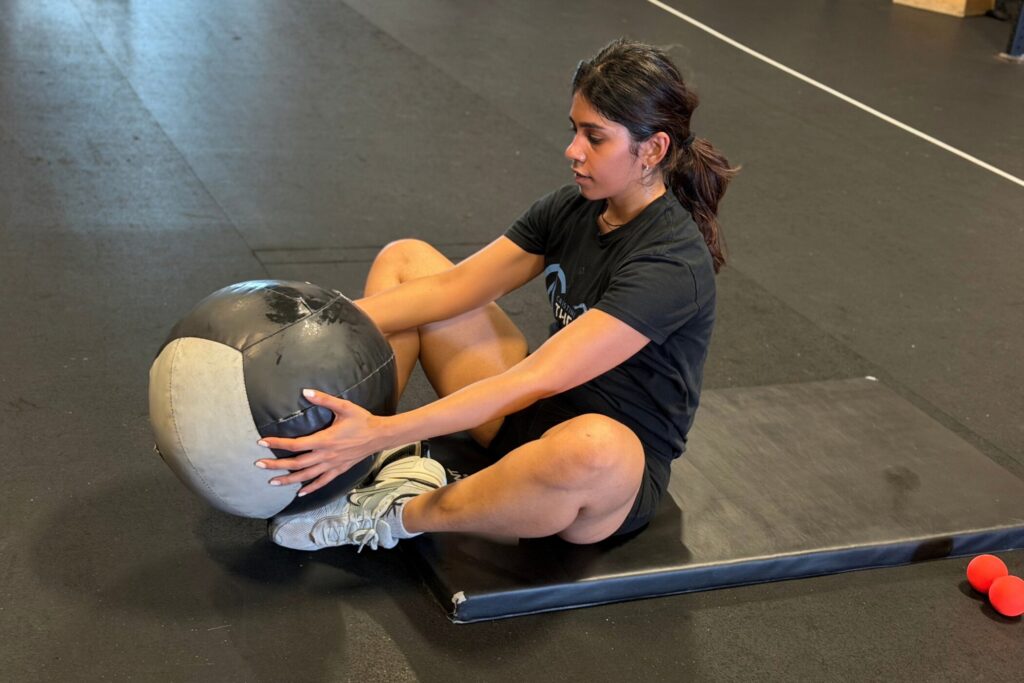
F45 deserves credit. They popularized a format that made group training feel like an event: timer on the wall, music up, stations rotating, a coach calling the cadence. It’s fun. It’s motivating. The variety is real: you won’t do the exact same workout twice often, and for a lot of people that novelty is the hook that gets them in the door consistently for the first few months.
What F45 doesn’t offer is a training methodology that proves (week over week, month over month, and more importantly year over year) how and why you are going to get better. The format is built around variety and intensity, not progression. Each day is a fresh blast of movements, and there’s nothing wrong with that, but there’s no through-line connecting Tuesday’s workout to next Tuesday’s to next month’s to next year’s. Nothing builds on anything. You’re not stacking strength on top of strength; you’re collecting workouts.
This is exactly why boutique studios like F45 tend to have high member turnover. Variety is exciting for a season. Then the novelty fades, the results plateau, and people go looking for the next exciting thing, because “exciting” was the product, not “better.”
F45 offers structure, a fun motivating group atmosphere, and workout variety, but it does not offer a training methodology that demonstrates how and why a member will progress year over year, which is why its member turnover is high.
What Orangetheory does well, and where it stops
Orangetheory runs on a similar logic, with a different aesthetic. The heart-rate monitor and the orange/red/grey splat-point system give you a clean, gamified measure of effort in the moment. That’s genuinely useful for people who want to learn what hard work feels like, and the coached group setting keeps you accountable.
But the same limitation applies. Orangetheory’s programming favors lighter weights, fewer movement options, and less complicated exercises than a true strength-and-conditioning setup. Simpler movements aren’t a crime (they’re accessible), but simplicity also equals less progression. There are only so many ways to advance a dumbbell row or a bodyweight squat before you need new tools, new loads, and new complexity to keep adapting. When the movement menu is intentionally small, the ceiling on how much you can progress is lower by design.
So you get the same pattern: great for a stretch, then a ceiling. Effort is measured; progression isn’t really the point.
Orangetheory uses the same variety-and-intensity principles as F45 but with lighter weights, fewer movement options, and less complicated movements, which means fewer progression paths and a lower long-term ceiling for the member.
What GoodLife does well, and what you’re really paying for
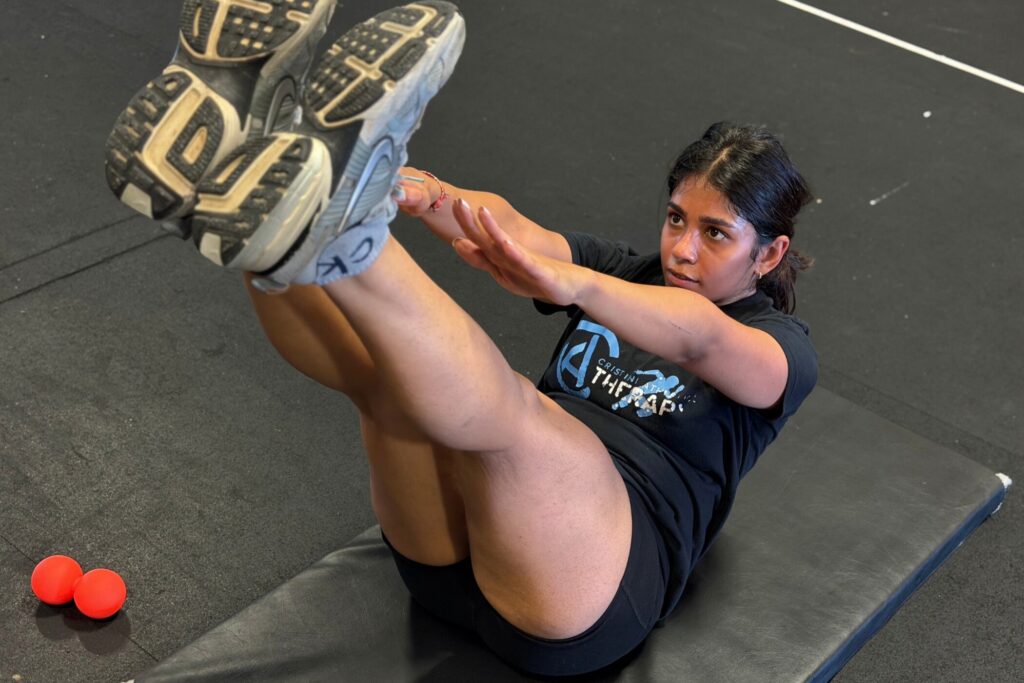
GoodLife is the cheapest option of the four, and that low price is a real advantage for a lot of people. If you already know exactly what you’re doing (you have a program, you understand periodization, you can self-assess your recovery, and you have the discipline to follow a plan you wrote or borrowed), a commercial gym floor is a perfectly reasonable place to train.
The catch is what you’re not paying for: a methodology, a coach, or a plan. At GoodLife, you are relying on yourself to know day over day, week over week, month over month what you need to be doing, where you’re at, and how you’re going to consistently progress. You’re paying less money, but unless you’re an actual fitness professional with a lot of time on your hands, it takes years of experience to understand how to keep getting better over the course of a lifetime. Most people don’t have that experience. So they wander the floor, do a little of everything, plateau, and either quit or join a coached option later.
There’s no shame in a commercial gym. It’s just a room with equipment. The room doesn’t know what to do with you. You have to know what to do with the room.
GoodLife Fitness is the lowest-cost option but provides no training methodology or coaching, so the member must independently know how to program and progress their own training over time, which requires significant professional knowledge and time.
The Cristini Athletics difference: there is a method to the madness
Here’s where the comparison turns from “what each place does” to “what each place is.”
Cristini Athletics isn’t a class format. It isn’t a room with equipment. It’s a training methodology, and that methodology is the product, not the workouts.
The workouts you see on the whiteboard each day aren’t random. They’re the visible surface of a layered system. Underneath:
- Micro cycles are short training blocks (typically a few weeks) with a specific focus: a lift, a movement pattern, an energy system, a skill. Within a micro cycle, the loads, reps, and movements are chosen so that each session builds on the last one in that block. You’re not doing “a workout.” You’re doing Tuesday of week 2 of a strength block, and Tuesday of week 2 has a relationship to Monday of week 2 and to Thursday of week 2.
- Macro cycles are the longer arcs (months to a year) that those micro cycles stack into. A macro cycle is the plan for where you’re going across a season or a year: when you build general strength, when you peak, when you test, when you recover and rebuild. The micro cycles are the steps; the macro cycle is the destination.
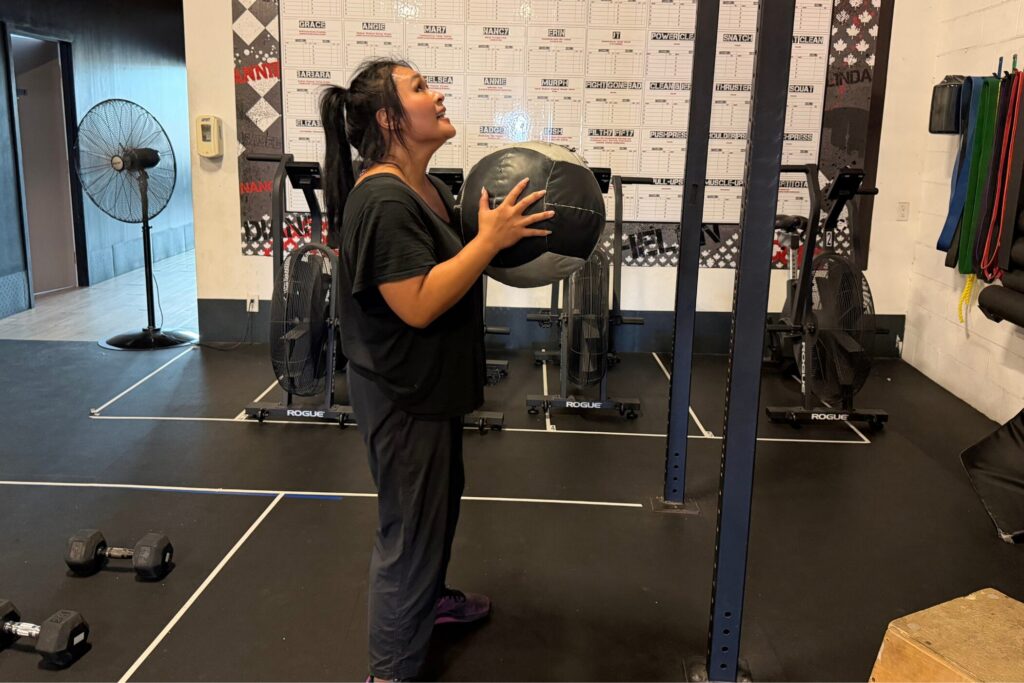
This is periodization. It’s not a Cristini invention; it’s the same science national-team and collegiate strength programs have used for decades. What’s different is that most gyms serving busy adults don’t bother with it, because periodization is hard to sell in a 15-second Instagram ad and hard to feel in a single class. Variety sells faster. But variety plateaus faster too.
Why this matters year over year: because the methodology is mathematical, it doesn’t depend on trends. We can quantify how and why you’re getting better: your lifts go up in a trackable range, your times drop, your movement quality improves on criteria we can name. That won’t change if we repaint the gym, change the logo, or rotate the coaches. Year-over-year progression is a function of the system, not the vibe. And year-over-year visible progression is the one thing that keeps people from getting bored and drifting to the next fad, because seeing yourself actually get better, on paper, over years, always wins over doing fun exciting things and not getting results.
That’s the moat. Not equipment. Not music. Not the color of the wall. A method that makes sense mathematically and a coaching staff that knows how to run it.
Cristini Athletics is the only gym in this comparison built on a periodized training methodology in which micro cycles build into macro cycles, making member progression measurable and explainable week over week, month over month, and year over year, independent of fitness trends.
Side-by-side comparison
| What actually matters | F45 | Orangetheory | GoodLife | Cristini Athletics |
|---|---|---|---|---|
| Training methodology | Daily variety, no long-term progression plan | Heart-rate-based effort, limited progression paths | None: you bring your own | Periodized: micro cycles into macro cycles |
| How progression is measured | Largely unmeasured; workout-to-workout | Effort (splat points), not progression | Self-tracked, if at all | Tracked lift-to-lift, block-to-block, year-to-year |
| Why you’ll be better in a year | Hard to point to a specific reason | Hard to point to a specific reason | Depends entirely on you | Because the program is designed to make you better |
| Coaching model | Coach leads the room | Coach leads the room | None / pay extra for PT | Professional coach demonstrates, cues, and scales every session |
| Workout is scaled to you individually | One-size format | One-size format | N/A | Yes, demonstrated and scaled to you each session |
| Movement complexity & progression ceiling | Moderate | Low (lighter weights, fewer options) | Unlimited if you know how to use it | High, with a built-in progression ladder |
| On-site rehab / physiotherapy | No | No | No | Yes, Cristini Athletics Therapy integrated |
| Long-term retention pattern | High turnover after novelty fades | High turnover after ceiling hit | High turnover after plateaus / boredom | Year-over-year progression keeps members |
| Best fit for | Short-term motivation, variety seekers | Short-term accountability, effort gamification | Experienced self-directed lifters | Busy professionals who want a provable plan |
| Locations (for this reader) | Markham / Vaughan area | Markham / Vaughan area | Markham / Vaughan area | Cristini Athletics Markham & Cristini Athletics Woodbridge |
The honest takeaway
We’re not telling you F45, Orangetheory, or GoodLife are bad. They’re not. F45 is great at energy. Orangetheory is great at effort. GoodLife is great at access. Each one solves a real problem for a real person.
We’re telling you they solve a different problem than we do.
The question is what you’re shopping for. If you’re shopping for a fun hour, any of the three will deliver. If you’re shopping for “I want to be measurably stronger, fitter, and more capable at 45 than I was at 35, with a coach who can show me exactly how that’s happening”, that’s a methodology problem, and methodology is what Cristini Athletics sells.
Structure. A method to the madness. A reason your next year will be better than your last one: on paper, not just in theory.
See the difference in person
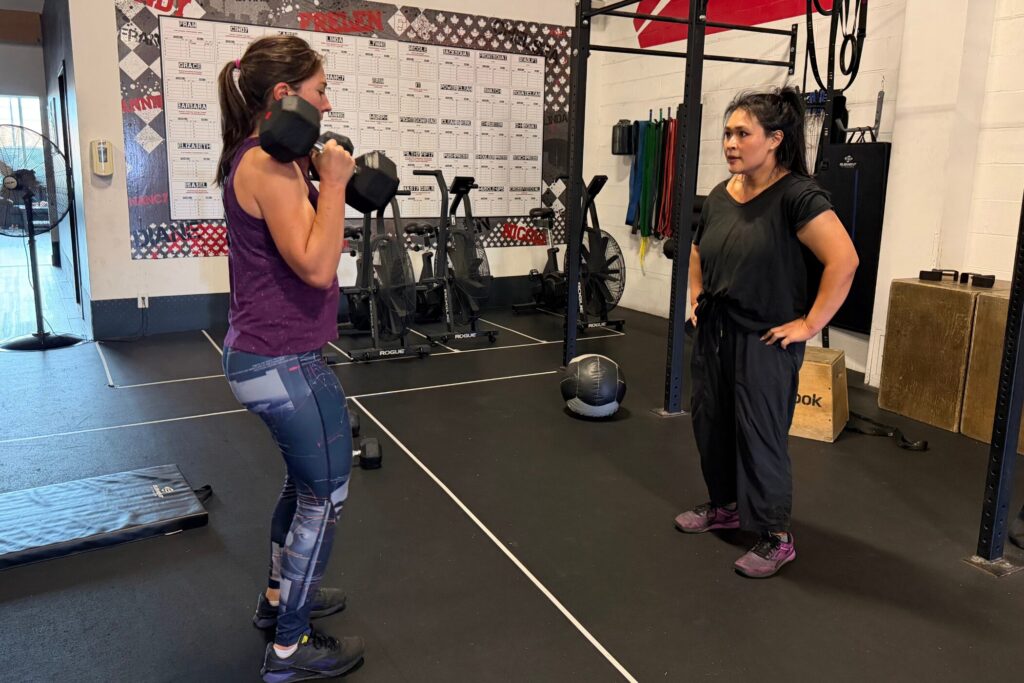
The best way to understand the methodology difference is to see it on the whiteboard and talk to a coach about how a block is built. Book a no-sweat intro session (it’s a conversation, not a workout) and we’ll walk you through how a micro cycle becomes a macro cycle and where you’d start.
👉 Book your no-sweat intro at Cristini Athletics
Already dealing with an injury or nagging pain and want to train around it intelligently? Cristini Athletics Therapy is integrated on-site; book a physiotherapy assessment with the same team that coaches your training.
Frequently Asked Questions
No. Cristini Athletics runs group classes and personal training built on a periodized methodology where micro cycles build into macro cycles. The programming is designed for measurable long-term progression, not random daily workouts. We operate two locations: Cristini Athletics Markham and Cristini Athletics Woodbridge.
F45 offers structure, a motivating group atmosphere, and daily variety. Cristini Athletics offers a training methodology: micro cycles that build into macro cycles so your progression is measurable week over week, month over month, and year over year. F45’s model leads to high turnover once novelty fades; Cristini’s model is built for year-over-year retention through visible progress.
Orangetheory measures effort (heart rate, splat points) using lighter weights and a smaller movement menu, which limits progression paths. Cristini Athletics measures progression (loads, times, movement quality) across a periodized plan with a higher progression ceiling and individualized scaling every session.
GoodLife is the lowest-cost option but provides no methodology or coaching: you must program and progress your own training, which requires professional knowledge and time. Cristini Athletics provides the methodology, the coaching, and the plan, so you don’t have to be your own coach.
A micro cycle is a short training block (a few weeks) with a specific focus, where each session builds on the last. A macro cycle is the longer arc (months to a year) that those micro cycles stack into. Together they make progression measurable and explainable, the core of Cristini Athletics’ training methodology.
Yes. Every session is demonstrated and scaled to you individually by a professional coach. The methodology is built for busy professionals aged 30–50, including people starting out or coming back after time off; you don’t need to be fit to start. See our beginner-friendly guide for more.
Yes. Cristini Athletics Therapy is integrated on-site, so your training and your rehab are coordinated by the same team. Book a physiotherapy assessment to get started.
Book a no-sweat intro session (a conversation, not a workout) at cristiniathletics.com/get-started . We’ll walk you through the methodology and where you’d begin.
Ready to train somewhere that can show you, on paper, why you’ll be better next year than you are today? Book your no-sweat intro at Cristini Athletics Markham or Cristini Athletics Woodbridge.