

This November and December, we’re bringing an old-school benchmark into focus at Cristini Athletics Markham and Cristini Athletics Woodbridge: the 2,000-metre row.
Over eight weeks, our class programming will give you chances to improve your rowing, build conditioning, and work toward a measurable goal.
Quick answer: The 2K row is a fixed-distance test on the Concept2 rower: row 2,000 metres as fast as you can and record your time. It measures cardiorespiratory endurance and muscular stamina, and it teaches you how to pace and how to keep good technique when you’re tired.
Fitness trends come and go, but some tests stick around because they keep challenging us and give useful feedback. The 2K is one of them. The task is simple: sit down, row 2,000 metres, record your time. Doing it well takes practice.
What is the 2K row test?
The 2K row is a benchmark workout where you row 2,000 metres on a Concept2 rower as fast as you can. Your finishing time and your average 500-metre split become your score, so you can retest later and see real change.
It’s useful because there are no hidden variables. Same distance, same machine, objective result.
A benchmark with history
In 2002, CrossFit founder Greg Glassman published Strategies for a Seven Minute 2K on the Concept II Rower in the CrossFit Journal. He described the seven-minute 2K as “a prominent benchmark in an athlete’s development” and explained several ways to train toward it.
More than two decades later, the appeal is the same: a fixed distance, an objective result, and room to improve.
Seven minutes won’t be everyone’s target, and it doesn’t need to be. Your goal should reflect your starting point, experience, and ability. What matters is a meaningful challenge and consistent work toward it.
What is a good 2K row time?
A “good” time depends on your age, training history, and body size. Rather than chase a number someone else posted, pick a target based on your first test. Here’s how 2K finishing times convert to the 500-metre split you’ll see on the monitor:
| 2K finish time | Average 500m split | How to think about it |
|---|---|---|
| 7:00 | 1:45 | A prominent long-standing CrossFit benchmark |
| 7:30 | 1:52.5 | Strong, well-trained rower |
| 8:00 | 2:00 | Solid, experienced target |
| 8:30 | 2:07.5 | Great goal for a consistent trainee |
| 9:00 | 2:15 | Excellent first-benchmark target |
| 10:00 | 2:30 | Perfectly respectable starting point |
How to use it: divide your target time by four to get your target split. Then try to hold that split for all four 500-metre segments.
Why we’re making it a focus
Rowing challenges your cardiorespiratory endurance and muscular stamina, meaning your ability to keep working as your breathing climbs and your muscles fatigue. CrossFit HQ identifies both qualities in its rowing programming.
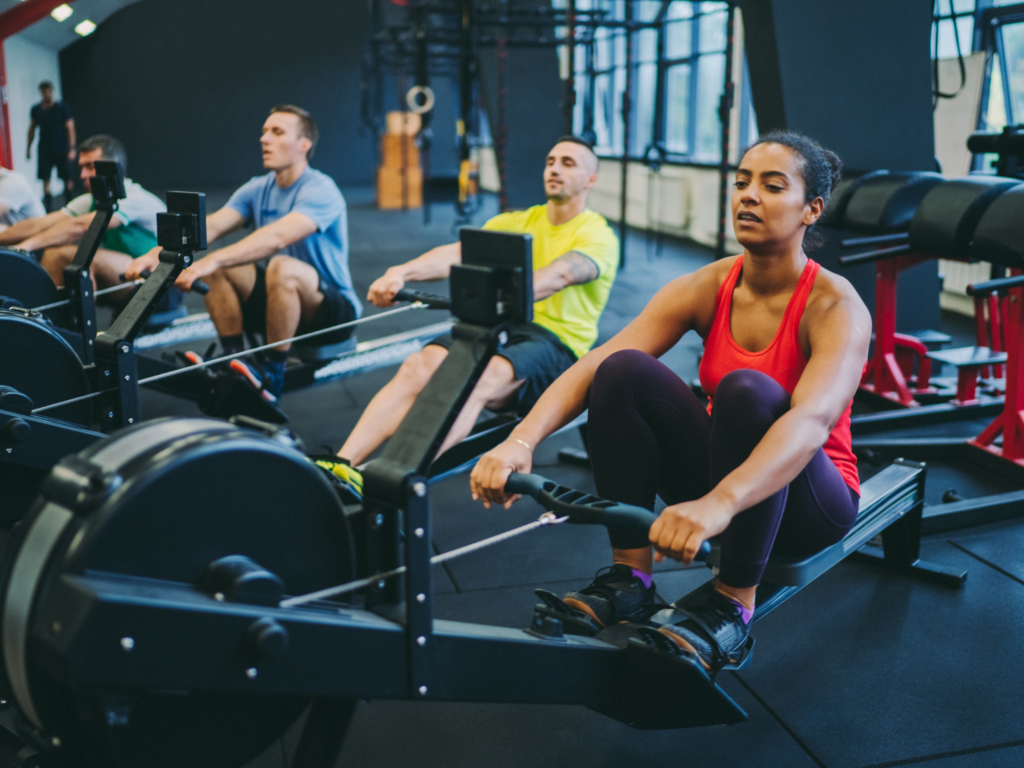
The rower is also one of the most underused tools in most gyms. It’s non-impact, full-body, and has a big range of motion through the ankles, knees, and hips. It’s beginner-safe, yet it will challenge advanced athletes. That makes it a good fit for a room that includes first-timers and experienced competitors.
Our goal is to help you sustain effective effort for longer. We want you to understand your pace, move efficiently, and stay composed when the workout gets hard.
The rower gives immediate feedback. You can see your pace change, notice when output drops, and learn how technique and effort adjustments change your result.
The 2K teaches you how to pace
If you’ve ever started a workout too fast, you know how expensive that first minute can be.
The CrossFit Journal article Pulling a Sub-7 Minute 2K Row—without Rowing? tells that story well. EvaClaire Synkowski describes starting aggressively, struggling to settle into a rhythm, and fading toward the finish. She finished slower than the previous year despite feeling stronger going in.
That’s a lesson for any athlete: effort needs a plan.
Throughout this block, pay attention to your 500-metre split and how it feels. A simple way to think about a 2K:
- First 500m: settle in. Hold your target split, not faster.
- Middle 1,000m: stay steady and composed. This is where most people drift.
- Final 500m: whatever you have left, spend it.
Learning what you can sustain helps you approach every session with more purpose and make better decisions when fatigue builds.
Better rowing technique, better 2K
A good stroke needs your legs, hips, and arms to work together, in order. Pulling harder only gets you so far if timing and technique fall apart.
- Drive: legs first, then lean back through the hips, then pull with the arms.
- Recovery: the reverse. Arms away, hips hinge forward, then the knees bend.
- Tempo: a faster drive and a more relaxed recovery usually beats rushing everything.
The most common mistakes we see are overusing the arms and low back, ignoring tempo, and skipping mobility work. Limited ankle, hip, or hamstring mobility often shows up as a compromised stroke, which is why we mix mobilization into the block.
Synkowski’s article also describes her mechanics deteriorating late in the race, even with coaching reminders. That’s something we’ll watch for in class. The aim is to build effective strokes you can repeat while tired.
If rowing aggravates your back, knees, or hips, you don’t have to push through it. Our team at Cristini Athletics Therapy can assess it. Book a physiotherapy appointment here.
Why eight weeks?
Improvement takes repeated practice, feedback, and time to apply what you’ve learned.
Glassman’s original article outlines several approaches to the same goal: timed efforts, distance efforts, target paces, and intervals. His broader lesson is that varied, progressive training helps an athlete move toward a specific milestone.
Our eight-week focus puts that principle into practice within class programming. Each session gives you something to learn from and build on. Sessions include the kinds of work Glassman described, such as target-pace pieces, intervals, and distance efforts.
How to get the most out of the 2K block
- Show up consistently. Rowing skill builds through repetition.
- Listen to your coaches. They’ll show you what to do, how to do it, and how to scale it to you.
- Record your results. A quick photo of your monitor captures your average pace and gives you data for future sessions.
- Know your target split. Use the table above.
- Judge progress broadly. A faster finish is great. So are more consistent splits, better technique, and more confidence going into a hard effort.
That’s why old-school benchmarks still earn a place in our programming: they give us a clear challenge and a reason to train with intention.
Frequently asked questions
What is a 2K row?A 2K row is a 2,000-metre test on the Concept2 rower. You row the distance as fast as you can and record your finishing time and average 500-metre split.
How do I pace a 2K row?Pick a target 500-metre split by dividing your goal time by four. Start at that split rather than faster, stay steady through the middle, and push in the final 500 metres.
What is a good 2K row time for a beginner?There’s no universal standard. A first 2K between roughly 9:00 and 10:30 is a common starting range. What matters more is your own improvement over eight weeks.
Is the 2K row hard on your body?Rowing is non-impact, so it’s easier on joints than running. It is a demanding effort for your lungs and legs, which is why pacing and technique matter. If you have pain, get it assessed before testing.
Do I need to be fit to start?No. Every row in class is scaled to the individual. You don’t need to be fit to start, and our coaches adjust distance, pace, and intensity to your level.
Where can I do rowing workouts in Markham or Woodbridge?Our group classes at Cristini Athletics Markham and Cristini Athletics Woodbridge include Concept2 rowing in our programming, led by professional coaches.
Ready to try it?
You don’t have to be fit to start, and it doesn’t have to be intimidating. Book a no-sweat intro session at Cristini Athletics Markham or Cristini Athletics Woodbridge, meet the coaches, and see how class works before you commit.
Book your no-sweat intro session
This November and December, bring your effort, be willing to learn, and give yourself eight weeks to see what you can improve.
About the author: Chris Cristini has 20 years of coaching experience and owns Cristini Athletics, two integrated gym and physiotherapy clinic locations in Markham and Woodbridge.