

Walk into any gym in Markham, Vaughan, or Toronto (including ours) and you’ll find a Concept2 rowing machine sitting quietly in the corner. It’s one of the most common pieces of equipment you can buy. It’s also one of the most underutilized.
The rowing machine isn’t ignored because it doesn’t work. It’s ignored because most people don’t understand the benefits, and even fewer understand the technique. So they hop on, pull with their arms and lower back for two minutes, feel awful, and go back to the treadmill.
This post fixes both. You’ll learn why the rower deserves a permanent spot in your routine, how to use it with proper form, and three workouts to rotate through the week.
If you’ve felt intimidated by the rower (or thought you needed to be “fit enough”), this guide is for you. The rowing machine is completely safe for beginners and extremely challenging for advanced athletes when done correctly. At Cristini Athletics, we incorporate it into our programming regularly.
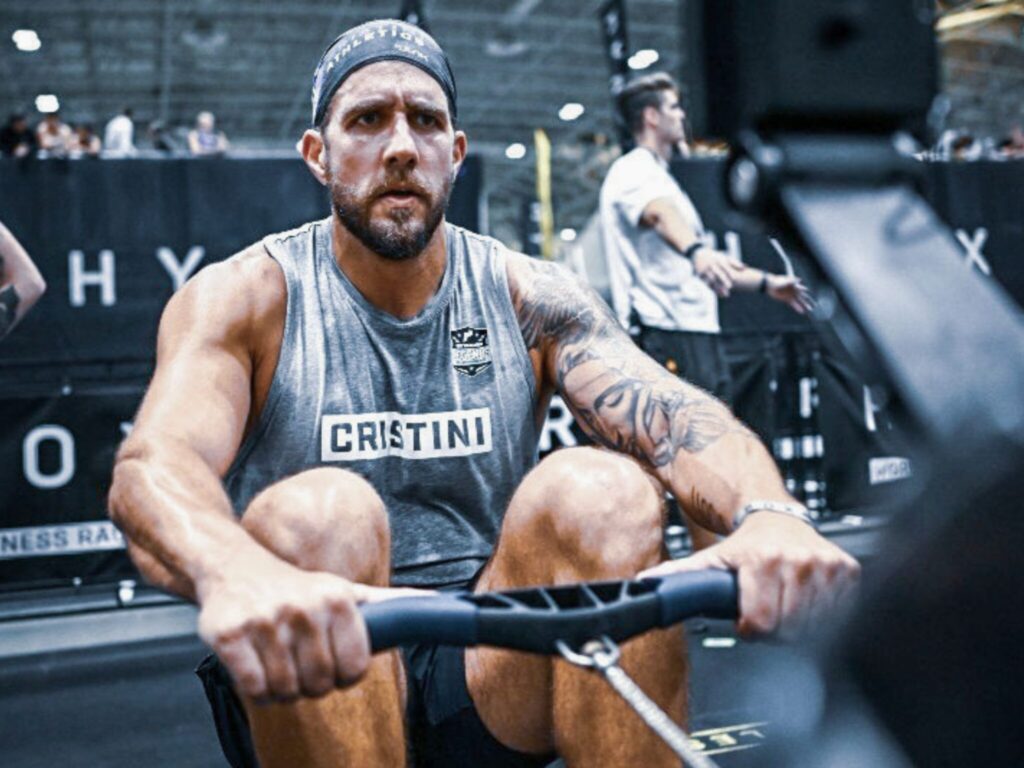
Why People Avoid the Rowing Machine
Before the benefits, let’s address why people skip the rower. If you’ve tried it once and hated it, it’s not the machine’s fault.
They use too much arms and lower back. The rowing stroke is a leg-driven movement. Most people pull with their arms and yank with their lower back. Your legs are the strongest muscles in your body: learn to drive with them and the rower transforms.
They don’t understand tempo. Rowing has a rhythm: powerful drive, controlled recovery. Most people rush both directions, which spikes heart rate and kills efficiency.
They don’t respect the movement. People treat the rower like an elliptical. But rowing is a skilled movement pattern, just like a squat or deadlift.
They don’t mobilize before using it. If you sit at a desk all day, you likely have tight hip flexors, lower back, hamstrings, and upper back. Combine that stiffness with poor technique and the rower feels terrible. Five minutes of mobilizing changes everything.
Every one is fixable.
The Benefits of Rowing Machine Workouts
Full-Body Exercise
Rowing engages nearly every major muscle group in a single stroke: legs, glutes, back, core, shoulders, and arms. A treadmill works your legs. A bike works your legs. A rower works everything.
Zero Impact: Safe on Your Joints
Rowing is a low-impact exercise with no landing force, no pounding, no stress on your ankles, knees, or hips. For busy professionals who want cardio without the wear and tear of running, the rowing machine is a knee-friendly exercise that lets you train hard without beating up your joints.
Large Range of Motion and Mobility
Unlike most cardio machines, the rowing stroke takes your body through full ankle dorsiflexion, deep knee flexion, and complete hip flexion and extension. Regular rowing develops ankle, knee, and hip mobility, not just strength and cardio.
Builds a Proper Motor Pattern: Legs to Hands
The rowing stroke teaches a fundamental pattern: power originates in the legs, transfers through the torso, and finishes at the hands. Legs drive first, then the back swings open, then the arms pull: the same sequence used in deadlifts, cleans, and lifting a box off the floor.
Adjustable Resistance and Tempo
The Concept2 has a damper setting (1–10). Higher settings (7–10) make each stroke heavier and more leg-driven. Lower settings (3–5) make the stroke lighter and faster, demanding more from the cardiovascular system. Adjust stroke tempo to control heart rate; the same machine gives you different workouts.
Beginner-Safe, Advanced-Challenging
The difficulty comes from how hard you push, not the machine. A beginner gets a productive workout on day one. An advanced athlete can be on the floor in five minutes doing the same movement. No weight to drop, no impact to fear.
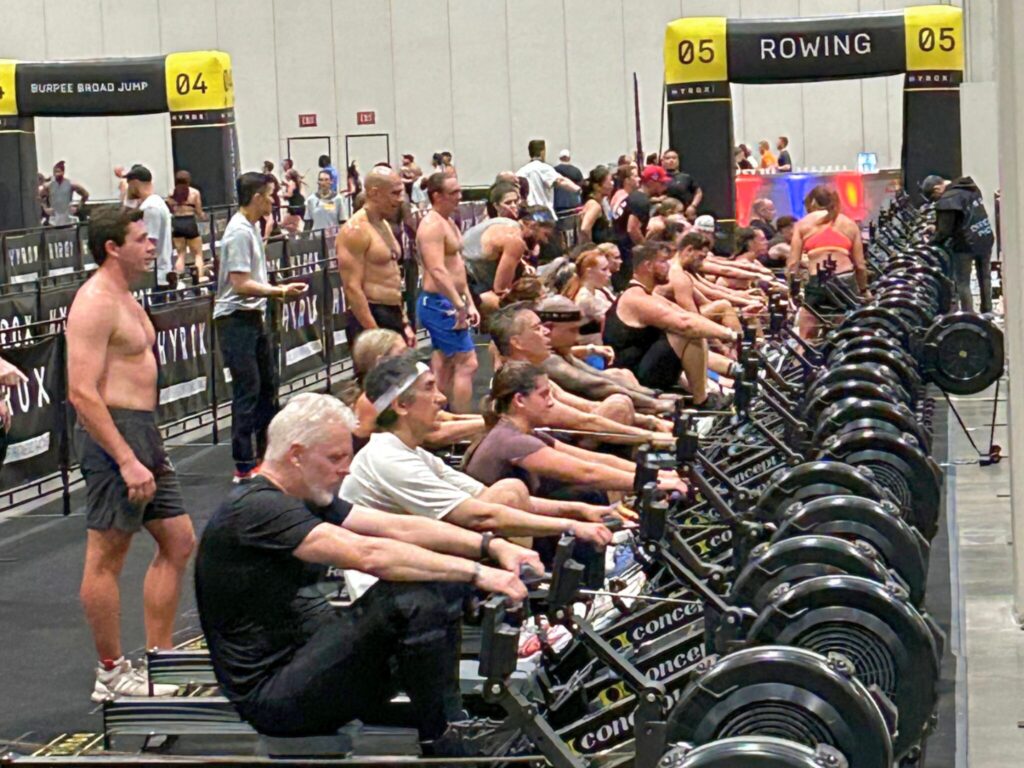
Weight Loss and Calorie Burn
Rowing burns significant calories per session, comparable to running, with none of the impact. Combined with the strength component, rowing supports both fat loss and muscle retention.
Posture Improvement
Most cardio machines do nothing for your posture. Rowing reinforces it: the finish requires sitting tall with shoulders down, the catch requires a long spine hinged from the hips. Over time, this trains the postural muscles that counteract the slouched-forward desk position. Rowing machine back pain is almost always a technique problem: pulling with the lower back instead of driving with the legs. With proper form, rowing strengthens the muscles that protect your spine.
Rowing Machine vs. Treadmill vs. Stationary Bike
| Feature | Rowing Machine (Concept2) | Treadmill (Running) | Stationary Bike |
|---|---|---|---|
| Muscles Engaged | Full body: legs, glutes, back, core, shoulders, arms | Primarily lower body | Primarily lower body |
| Impact Level | Zero impact | High impact | Zero impact |
| Calorie Burn (30 min, moderate) | ~250–350 kcal | ~300–400 kcal | ~200–300 kcal |
| Mobility Benefit | High: full ankle, knee, hip range of motion | Low | Low |
| Skill Requirement | Moderate: proper technique needed | Low | Low |
| Joint Stress | Minimal with correct technique | High: ankles, knees, hips | Minimal |
| Strength Component | Yes, resistance on every stroke | Minimal | Minimal |
| Best For | Full-body low-impact cardio, strength + cardio combined | Cardiovascular endurance, run training | Knee-friendly steady-state cardio |
The rowing machine vs. treadmill question isn’t which is “better”; it’s which fits your goals. For full-body training, low impact, and mobility in one machine, the rower wins.
Proper Concept2 Rowing Technique: The Four Phases
The Catch (Starting Position)
Shins vertical, arms fully extended toward the flywheel, back set in a strong, slightly forward-leaning position. Think deadlift setup: hips hinged, spine long, chest up.
The Drive (Power Phase)
The order is critical:
- Legs press first: drive through your heels, extending knees and hips.
- Back swings open: once legs are mostly extended, torso swings from forward lean to slightly back.
- Arms pull last: only after legs and back have done their job, pull the handle to your sternum.
Coaching cue: “legs, back, arms” on the drive.
The Finish (End Position)
Legs flat, back slightly past vertical, handle at sternum, elbows behind you, shoulders relaxed. Tall and strong.
The Recovery (Return to the Catch)
The reverse of the drive:
- Arms extend first: straighten arms toward the flywheel.
- Back tilts forward: hinge from the hips to the forward lean.
- Knees bend last: once the handle clears your knees, slide forward to the catch.
Coaching cue: “arms, back, legs” on the recovery. The recovery should be slower than the drive, roughly 1:2.
Common Errors to Avoid
- Pulling with arms first: overloads your back. Think “legs first.”
- Rushing the recovery: throws off rhythm.
- Over-reaching at the catch: past vertical shins strains the lower back.
- Shooting the seat back: legs extend but the handle doesn’t move.
Rowing Machine Exercises: Three Weekly Workouts
Rotate through these three sessions across the week, each with a different intention. All are suitable for beginners and scalable for advanced athletes.
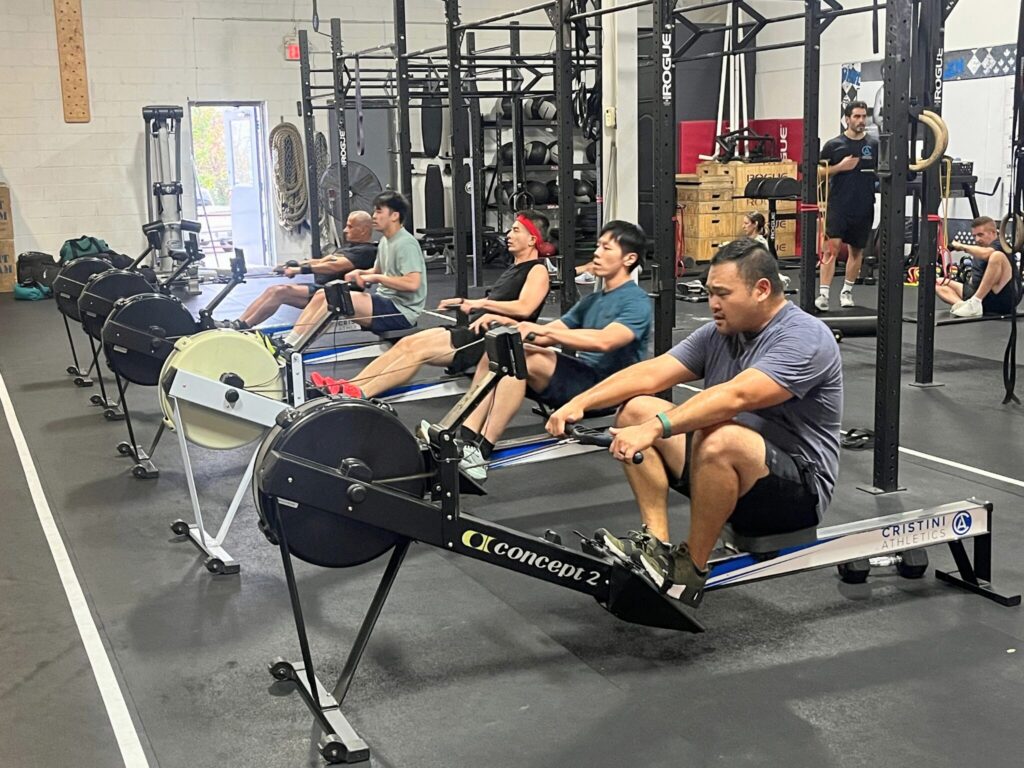
Workout 1: Technique Builder
Intention: Reinforce proper form. Low-intensity, mechanics-focused.
- Damper: 4–5
- 5-minute easy warm-up (focus on “legs, back, arms” / “arms, back, legs”)
- 5 × 2 minutes steady, 1 minute rest between, each interval focus on one cue: smooth drive, slow recovery, full catch, tall finish, relaxed shoulders
- 5-minute cool-down
- Advanced: 5 × 4 minutes at stroke rate 22–24, focus on power per stroke.
Workout 2: Steady-State Endurance
Intention: Build aerobic capacity: your “long, slow” session.
- Damper: 5
- 5-minute warm-up
- 20 minutes continuous at a conversational pace (you can speak in short sentences), stroke rate 20–24
- 5-minute cool-down
- Advanced: Extend to 30–40 minutes or hold a consistent 500m split at stroke rate 26–28.
Workout 3: Interval Power
Intention: Build power and speed. Your hardest session of the week.
- Damper: 6–7
- 5-minute warm-up
- 8 rounds: 30 seconds max effort / 30 seconds easy row
- 5-minute cool-down
- Advanced: 10–12 rounds, or 1 minute hard / 1 minute easy. Track meters per hard interval.
Weekly Schedule Example
| Day | Workout | Duration |
|---|---|---|
| Monday | Technique Builder | ~25 min |
| Wednesday | Steady-State Endurance | ~30 min |
| Friday | Interval Power | ~20 min |
Three sessions, three goals, one machine: a complete weekly cardio program without a treadmill.
Frequently Asked Questions
A rowing machine provides a full-body, low-impact workout that engages the legs, glutes, back, core, shoulders, and arms in every stroke. It builds cardiovascular endurance, muscular strength, and mobility simultaneously, burns calories efficiently, and improves posture. The Concept2 is adjustable in resistance and tempo, making it suitable for both beginners and advanced athletes.
Yes. It’s zero-impact and intensity is controlled by how hard you push. A beginner can get a productive session on day one. The only requirement is learning proper form, which a coach can teach in a single session.
The quadriceps, hamstrings, glutes, and calves (drive), the core and lower back (stabilization), the lats, rhomboids, traps, rear deltoids, and biceps (pull), and the forearms (grip). It’s one of the few cardio machines that engages both upper and lower body in every repetition.
Start with 10–15 minutes at an easy pace, focusing on technique over speed. Break it into intervals (e.g., 5 × 2 minutes with 1 minute rest). As fitness improves, extend to 20–30 minutes.
Yes. Rowing burns a significant number of calories per session, comparable to running but without the joint impact. Combined with consistent training and a sensible nutrition approach, rowing supports fat loss while preserving muscle.
Rowing is zero-impact: no landing force on your knees, ankles, or hips. Back comfort depends on technique: when you drive with your legs and maintain a set back, rowing strengthens the muscles that support the spine. Poor technique can cause discomfort, which is why proper form matters.
Four phases: the catch (shins vertical, arms extended, back set), the drive (legs press first, then back swings open, then arms pull), the finish (legs flat, back slightly past vertical, handle at sternum), and the recovery (arms extend first, then back tilts forward, then knees bend). The key cue is “legs, back, arms” on the drive and “arms, back, legs” on the recovery.
2–3 sessions per week is sufficient. Rotate between technique, steady-state, and interval sessions. Consistency beats intensity: three moderate sessions a week beats one brutal session followed by a month of avoidance.
Try the Rower With a Coach at Cristini Athletics
Reading about proper rowing form is one thing. Feeling it with a coach is something else.
If you’re in Markham or Vaughan and want to learn the rower the right way (with hands-on coaching, in a supportive environment where no one expects you to already be fit), book a no-sweat intro session at Cristini Athletics.
We have two locations: Cristini Athletics Markham and Cristini Athletics Woodbridge. Both have Concept2 rowers and coaches who’ll teach you the technique from the ground up.
You don’t need to be in shape to start. You just need to start.
More training guidance on the Cristini Athletics blog.