

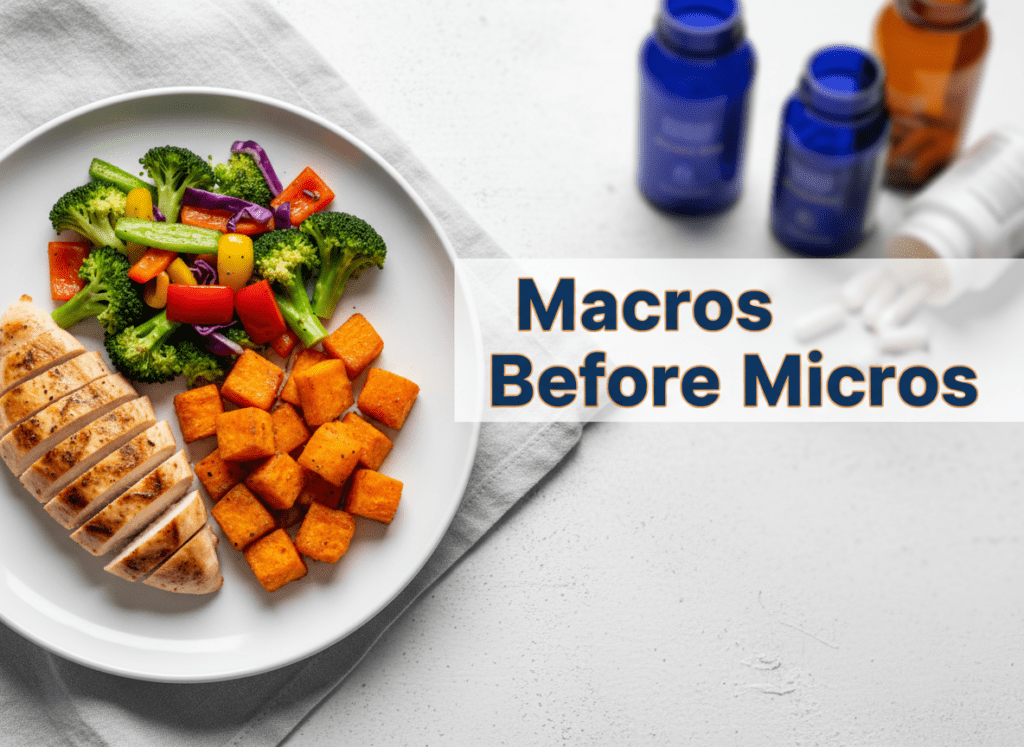
Worry about the macros before the micros.
Because in today’s nutrition world, people are obsessed with the small things before they’ve earned the right to worry about them.
People will debate:
- Keto vs. low-carb
- Carnivore
- Paleo
- Whole30
- “Clean eating”
- Detoxes/juice cleanses
- Intermittent fasting (16:8, OMAD)
- The newest supplement stack (magnesium, greens powders, fat burners, collagen, etc.)
Meanwhile, the biggest driver of results is still the most ignored:
Do you consistently eat the right amount of calories and macros for your body and your goal?
If not, the “micros” conversation is mostly a distraction.
The uncomfortable truth: most people skip the foundation
Micronutrients matter. Supplements can help in the right context.
But if you don’t know:
- How many calories you should be eating for your current weight and activity level
- How many calories you should be eating for your desired weight
- The balance of protein, carbs, and fats your body needs
- The daily grams that make that balance real
…then focusing on micros is like upgrading the rims on a car with no engine.
You’re trying to optimize something you haven’t built yet.
Why macros come first
Macros are the foundation because they control the big rocks:
- Energy balance (fat loss, maintenance, muscle gain)
- Performance in workouts
- Recovery and sleep quality
- Hunger and cravings
- Consistency (the thing that actually changes your body)
When you follow a macro plan consistently for a period of time, you finally get real data:
- How your body responds to a specific intake
- How your energy feels during the day
- How your training output changes
- How your sleep and recovery improve (or don’t)
That’s the point.
Not perfection. Not restriction. Control and awareness.
“But I eat healthy…” isn’t a plan
A lot of people think they’re doing well because they eat “healthy foods.”
But you can absolutely:
- Eat healthy foods and still overeat
- Eat healthy foods and still under-eat
- Eat healthy foods and still miss protein
- Eat healthy foods and still feel exhausted
Because “healthy” doesn’t automatically mean aligned with your goal.
Tracking macros forces you to answer the real questions:
- How much are you actually eating?
- Is it enough protein to support your body?
- Are your carbs supporting training or sabotaging recovery?
- Are your fats balanced or accidentally sky-high?
And once you understand that foundation, you can start choosing better sources of energy more naturally:
- More whole foods
- More lean proteins
- More high-fiber carbs
- More intentional fats
Instead of living on calorie-dense, ultra-processed “small portions” that add up fast.
You have to earn the right to worry about the little things
If you can’t consistently hit your calories and macros, then stressing over:
- The perfect supplement
- The perfect fasting window
- The perfect “superfood”
- The perfect micronutrient breakdown
…won’t move the needle.
It just prolongs the process.
It keeps you busy without making you better.
The real goal: a plan you can live with for the rest of your life
Here’s the question people should be asking:
“Is this sustainable for the rest of my life?”
Not:
- “Can I do this for 3–6 weeks?”
- “Can I white-knuckle this until I lose weight?”
Because if your plan is built on extremes, you’ll eventually snap back.
And when you go back to your old habits, you usually go back to your old body.
Sometimes worse.
Especially if you’ve been:
- Chronically under-eating
- Cutting out foods you actually enjoy
- Running your stress through the roof
Restriction has a cost.
And for a lot of people, that cost shows up later as bingeing, burnout, and rebound weight gain.
If your nutrition plan makes you miserable, it’s not a “discipline problem”
If your plan requires you to live like this:
- You’re stressed because you have to bring Tupperware everywhere
- You avoid restaurants with friends because it “doesn’t fit the diet”
- You panic if you eat past a certain time
- You feel like a failure if you’re off by 50 calories
- You’re miserable because you’ve banned foods you love
That’s not “healthy.”
That’s not “lifestyle.”
That’s a short-term strategy that usually creates long-term problems.
Why macro-based eating actually gives you freedom
A good macro plan isn’t a cage.
It’s a framework.
It gives you control without turning food into a moral test.
You can:
- Eat balanced meals
- Enjoy foods you like
- Go out once a week and still stay on track
- Adjust the rest of your day instead of “starting over Monday”
That’s what sustainable nutrition looks like.
Not “I can’t eat carrots because there’s too much sugar.”
The takeaway
If you want real results, stop majoring in the minors.
Master calories and macros first.
Build consistency long enough to learn how your body responds.
Then—and only then—start worrying about the micros, supplements, and fine-tuning.
Because the people who win long-term aren’t the ones with the strictest diet.
They’re the ones who find a plan they can live with.
Want help building your macro foundation?
If you’re tired of bouncing between trendy diets and you want a simple, sustainable plan that fits your training and your real life, we can help you set your calories and macros properly—and actually stick to it.
Book a consult and let’s build something you can keep.
Author: Chris Cristini