

Why Under-Eating Is Sabotaging Your CrossFit Progress Especially After 40
You cut your portions. You skip breakfast. You say no to the rice, the toast, the extra egg. You train three, four, five times a week.
And the scale doesn’t move. Your Fran time doesn’t move. You feel tired by 3pm, sore for days, and quietly wonder if it’s just “your age.” It’s not.
After years of coaching a lot of that with women in their 40s, 50s, and 60s I can tell you the most common reason a hard-training woman stalls isn’t that she’s eating too much. It’s that she’s eating too little.
If you’ve been eating less but not losing weight, this post is for you.
The Paradox: Less Food, Worse Results
Here’s the thing no diet app will tell you: your body isn’t a calculator. It’s a system. And when that system senses less energy coming in than it needs especially on top of the stress of hard training it does the one thing it’s brilliant at.
It conserves.
Your metabolism slows. Your non-exercise movement drops (you fidget less, walk less, do less without noticing). Your recovery gets worse. Your sleep gets worse. And the scale that stubborn, misleading scale holds steady, because your body is now holding onto everything it has.
Here’s what surprises most women: you can actually end up eating less but gaining weight or at least, changing your body composition for the worse because you’re losing muscle while storing fat. Same number on the scale. Different body underneath.
For women in perimenopause and menopause, this is even more pronounced. Estrogen is already dropping, which changes how your body stores fat, builds muscle, and regulates hunger. Stack under-eating on top of that, and you’ve built the exact environment you were trying to avoid: a slower metabolism, less muscle, and more fat storage around the middle.
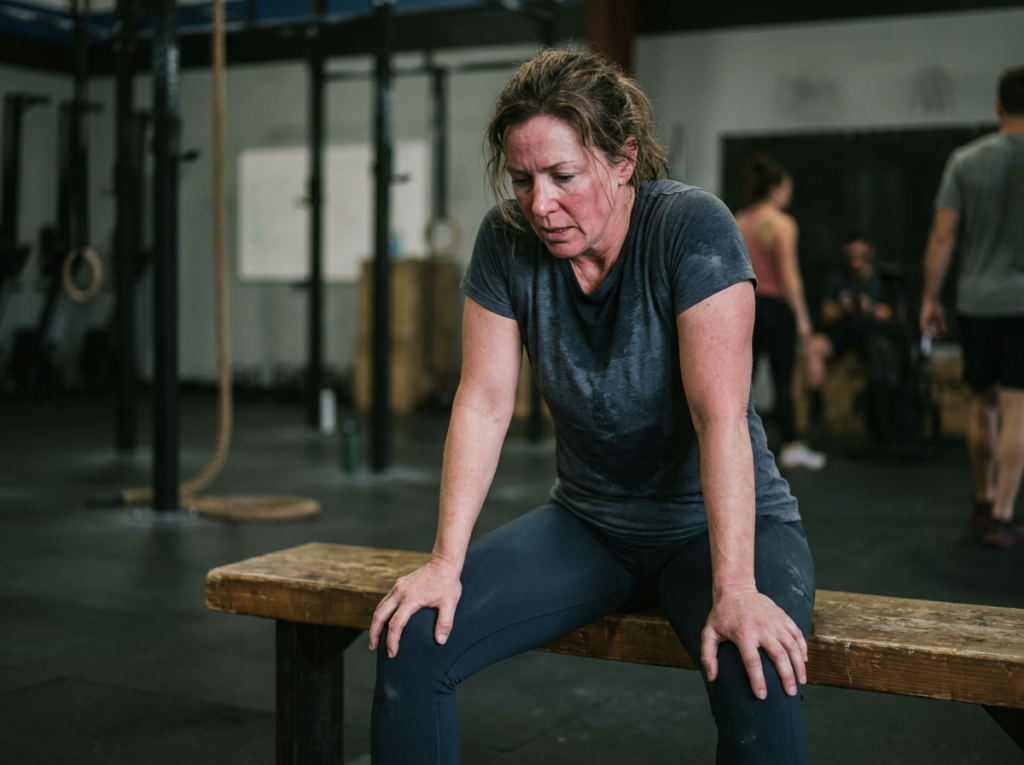
Why Under-Eating Kills Your CrossFit Performance Too
CrossFit is demanding. You’re asking your body to produce force, over and over pull, push, squat, lift, sprint. That work runs on fuel. Specifically: carbohydrates.
A lot of women I coach arrive terrified of carbs. They’ve been told for thirty years that bread is the enemy, that rice makes you fat, that fat makes you fat. So they eat a chicken breast and some spinach, train hard, and wonder why:
- Their back squat hasn’t gone up in a year
- They hit a wall four minutes into a 12-minute AMRAP
- They feel lightheaded on heavy deadlift days
- They’re sore until Wednesday from Monday’s workout
It’s not a strength problem. It’s a fuel problem.
You cannot out-coach under-fueling. Strength adaptations, muscle growth, power output, recovery every one of those requires adequate energy and adequate protein. When you under-eat, you’re asking your body to do hard work with no materials to rebuild from it. That’s not discipline. That’s sabotage.
The Muscle Loss Trap And Why It Matters More After 40
Here’s the part that matters most for fat loss in women over 40: when you eat too little, you don’t just lose fat. You lose muscle.
Muscle is your metabolism. It’s your independence. It’s your bone density. It’s the thing that lets you get up off the floor at 70, carry your groceries at 75, and not break a hip at 80.
Muscle loss in menopause is a real and accelerating problem not a background concern. After about 30, women naturally lose muscle unless they’re actively building it, and the loss accelerates after menopause. Estrogen was one of the signals that told your body to hold onto lean mass. When it drops, that signal weakens. The result: muscle loss during menopause happens faster and with less warning than most women expect.
Strength training (yes, CrossFit) is the stimulus that reverses this. Protein and total calories are the building materials. You need both.
When you under-eat:
- You can’t build the muscle the training is asking for
- You may actively lose muscle, which drops your metabolism further
- Bone density suffers muscle pulling on bone is what keeps it strong; less muscle means less stimulus
- Body composition gets worse even if weight stays the same less muscle, relatively more fat
So the woman who says “I just want to tone up” by eating less is doing the exact opposite of what her body needs.
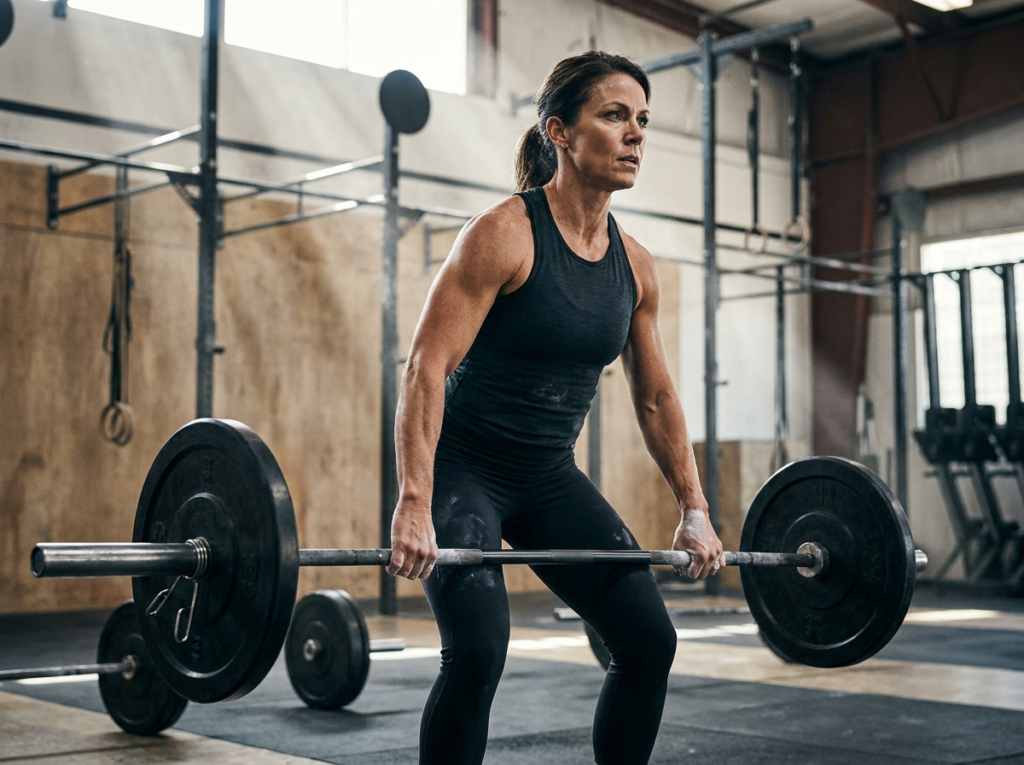
Nutrition for Women Over 40: How Much Should You Actually Eat?
I’m not going to hand you a calorie number here, because you don’t need a number from a blog you need one built around your body, your training, your life. That’s what our nutrition coaching is for.
But here’s what “enough” looks like in practice for active women in their 40s and 50s:
Protein: more than you think.
Most women I coach are genuinely shocked at how much protein we ask them to eat. A good target for active women, especially 40+, is roughly 0.7–1g per pound of body weight (about 1.6–2.2g per kg), spread across the day. That’s not a fad — it’s what the research supports for preserving and building muscle in this population. If you’re training hard and over 45, aim for the higher end.
Carbs: yes, really. Especially around training.
Carbs are your workout fuel. Oats, rice, potatoes, fruit, sourdough — these are not your enemy, they’re your performance. A woman who trains at 5pm and eats nothing but greens and chicken all day will not improve. The same woman who adds a banana and some rice will feel like a different athlete in two weeks.
Fats: for your hormones.
Olive oil, avocado, nuts, eggs, fatty fish. Hormones are built from fat. Cut it too low and you’re cutting the raw material your body uses to regulate the very systems that decide whether you store or burn.
Total food: enough that you’re not starving.
If you’re waking hungry, crashing mid-afternoon, or thinking about food constantly, you’re under-eating. Those aren’t discipline failures. They’re signals.
Signs You’re Under-Eating
If several of these apply to you, the issue may not be willpower it may be fuel:
- You’ve been training consistently for months with zero progress in the gym
- You’re exhausted outside of training brain fog, afternoon crashes, poor sleep
- You’re sore for three or four days after a normal workout
- You wake up hungry in the night, or you’ve stopped feeling hungry at all (loss of appetite is a red flag, not a win)
- Hair, skin, and nails are declining
- You feel cold all the time
- Your weight hasn’t moved but you feel “softer” or weaker
- Your mood is shorter, your motivation lower
If you’re nodding along, it’s not because you’re broken. It’s because you’ve been handed bad instructions.
The Reframe: This Isn’t a Willpower Problem
Here’s what I want every woman reading this to hear: if you’ve been eating less and less and getting nowhere, that’s not a character flaw. That’s a coaching gap.
You were handed a story eat less, weigh less, be better that was never built for a woman who trains hard, especially one whose hormones are changing. The diet culture that raised us wasn’t designed for athletes. It was designed for shrinking.
You don’t need to shrink. You need to fuel. And then rebuild. And then watch what your body does when it finally trusts that it’s not starving.
This is the work we do at Cristini Athletics. Not more rules, not another restrictive plan real, macro-based nutrition coaching that meets you where you are and adjusts as you train, recover, and live.
Your training, your nutrition, and if you ever need it your therapy all live under one roof at Cristini Athletics Markham and Cristini Athletics Woodbridge . One trusted source of truth. No guessing.
If you’re over 50 and looking for a program built specifically for your stage of life, our Fit Over 50 program is designed exactly for this smart training, proper fueling, no BS.
What to Do Next
If any of this sounds like you, here’s where to start no pressure, no contract, no 90-day anything:
- Stop cutting. If you’re eating below your needs, the first move is never “eat less and train more.” It’s “fuel better.”
- Add protein to every meal. Start there. That one change will move the needle.
- Add carbs around your training days. You’ll feel the difference in a week.
- Talk to a coach. You don’t have to figure this out alone. Our nutrition coaching is built for exactly this real food, real macros, real life, no diet-culture nonsense.
Not a member yet and want to see how we train and fuel at Cristini Athletics? Book a no-sweat intro session just a conversation, no workout, no commitment. Get started here .
Already training with us? Grab me or any coach after class. We’ll point you to our nutrition coaching.
You don’t need to eat less. You need to eat right.
FAQ
I’m eating less but not losing weight what’s going on?
If you’re training hard and chronically under-eating, your body likely shifted into conservation mode slowing metabolism, preserving fat, and potentially breaking down muscle. Raising your food intake to an appropriate level often improves energy, recovery, and body composition before the scale even moves.
Won’t eating more make me gain weight?
Not if you’re currently under-eating. When you’ve been under-fueling, raising food to an appropriate level often improves energy, recovery, and body composition sometimes before the scale even moves. The goal is never “eat less”; it’s “eat what your body actually needs.”
I can’t lose weight even in a calorie deficit why?
A few common reasons: your calculated deficit may not account for reduced metabolic adaptation (your body burning less because you’re eating less), you may be under-reporting intake, or chronic stress and poor sleep are counteracting your efforts. For active women over 40, this is especially common and it’s exactly why we use individualized macro coaching rather than generic calorie targets.
How do I know how many calories I should eat?
There’s no universal number it depends on your weight, training, age, and goals. That’s why we use individualized, macro-based coaching rather than handing out a generic number. Start with the protein target above and build from there.
I’m in menopause. Is this advice different for me?
In emphasis, yes. Women in menopause benefit from more protein and more strength training not less food. The hormonal shift makes muscle preservation harder, which makes fueling more important, not less.
Can I still lose weight while eating more?
Often, yes if you’ve been chronically under-eating. Your body has been conserving; when it finally gets adequate fuel, metabolism can recover and fat loss resumes. It’s rarely instant, but it’s far more sustainable than the cycle of cutting.
What if I’m not hungry enough to eat more?
Loss of appetite after long-term under-eating is common and it’s a sign your body has adapted to too little food. This is exactly where coaching helps: we rebuild intake gradually so it feels doable, not forced.
Do I need supplements?
Most active women benefit from enough protein, adequate total food, and often vitamin D and omega-3s. But food first. We don’t push supplements over real meals.
Written by Coach Vanessa
Cristini Athletics | CrossFit Markham — 9833 Markham Rd | CrossFit Woodbridge — 171 Marycroft Ave, Vaughan